
The names of potential suitors being floated in unconfirmed media reports to buy one of the 10 teams of the marquee Indian Premier League (IPL) included the promoters of the Adani Group, Manipal Group, Serum Institute of India and Zerodha.
As is often the case these days, the chatter on social media preceded the filing. On 1 October, more than a month before United Spirits made its filing, Adar Poonawalla of Serum Institute had posted on X: “At the right valuation, @RCBTweets is a great team…”
A couple of weeks later, unconfirmed media reports said even the owners of the Rajasthan Royals, another IPL team, were looking at a sale. Industrialist Harsh Goenka posted on X on 27 November: “I hear, not one, but two IPL teams are now up for sale-RCB and RR. It seems clear that people want to cash in the rich valuations today…”
Valuations is a key word in both those prospective deals. Since the IPL’s inception in 2008, valuations of IPL teams have principally gone northwards. In 2008, United Spirits, then led by Vijay Mallya, acquired the Bengaluru franchise for $111.6 million. The last robust and representative valuation figure for an IPL team comes from earlier this year, when the Torrent Group bought 67% of Gujarat Titans from private equity firm CVC Capital Partners at a reported valuation of about ₹7,500 crore (about $860 million).
Post its filing, it was reported that Diageo India was seeking a valuation of about $2 billion for RCB—more than twice that of Gujarat Titans, whose home base is Ahmedabad, and about 35 times its own 2024-25 revenue. Even for all the popularity and attention that RCB commands in the IPL, if that valuation materializes, it will smash valuation conventions of sporting franchises.
For RCB owner Diageo, valuation is one consideration. The other consideration is RCB’s position in the big picture of both Diageo India and, more so, its UK parent. Globally, the maker of Johnnie Walker whisky and Smirnoff vodka is facing many challenges—of revenue and profit pressure, and a stock that is at its lowest levels in a decade.

View Full Image
A 6 November Reuters report said “Diageo is attempting to cut costs and sell assets as the drinks industry faces cooling post-pandemic demand, tariff-related uncertainty and shifting consumer habits.”

In this backdrop, the anomaly of a listed company owning a business that contributes less than 2% to its consolidated revenue and has little overlap or synergies with that core business is sticking out.
Business anomaly
Across the world, sporting franchises are rarely owned as a hardcore business proposition by companies that have another core business. For example, in Major League Baseball (MLB) in the US, only two of the 30 franchises are owned by a company that has a separate primary corporate interest.
In both instances, the core business is media, which is closer to sports than, say, liquor. One of those teams is the Atlanta Braves, which is controlled by Liberty Media, with interests in the media, entertainment and sports industries. The second is the Toronto Blue Jays, which is owned by Canadian company Rogers Communications that provides wireless, cable and media services.
Instead, sports franchises are usually owned by promoters of these companies in their personal capacity—explicitly or implicitly. Even when routed through companies that are into other businesses, the connection is intended to further the various hues of business interests of the individual promoter than the main corporate entity. A case in point is Mumbai Indians being associated with the Mukesh Ambani Group rather than Reliance Industries.
In early 2008, when the IPL was born, liquor baron Mallya bought the rights to the Bengaluru franchise. Rather than use his personal funds, he routed that purchase through a 100% subsidiary of his listed liquor flagship, United Spirits. That 100% subsidiary is Royal Challengers Sports Pvt. Ltd (RCSPL). The 2008-09 annual report of United Spirits said: “The association will be used as an effective platform to fuel the growth of your company’s premium offerings.”
- केएल राहुल की अगुवाई वाली भारत को दक्षिण अफ्रीका में वनडे में दंडित क्यों किया गया? | क्रिकेट समाचार


View Full Image
With alcohol advertising banned in India, Mallya was banking on surrogate advertising—extension products under the alcohol brand name, a case in point being Royal Challenge, which is both a whisky and a mineral water brand. Thus, from 2008 to 2010, and in 2013, the RCB player shirts sported Royal Challenge branding. In 2011 and 2012, it was McDowell’s. RCB was crafted in the image of Mallya—bold, flamboyant and risk-taking.
Much has happened since. Mallya’s outsized bets in the airline business brought his downfall. He gradually sold United Spirits to Diageo over 2013 and 2014, and fled from India in early 2016 amid huge outstanding loans with Indian banks. The ownership of United Spirits also gave Diageo ownership of RCB. Post-2013, the RCB player jerseys sported Huawei, Hero Cycles, Gionee, Wrogn, Muthoot Fincorp and Qatar Airways—nothing to do with the liquor business.
Limits to growth
Under Diageo, a lot more beyond the branding on player shirts changed at RCSPL. Financial disclosures increased. The subsidiary’s financial dependency on the parent reduced. Thus, RCSPL loans outstanding from Diageo India reduced from a high of ₹413 crore in 2016-17 to ₹0 in 2023-24. Its financials also improved, as new, more lucrative IPL broadcasting deals lifted the financials of all teams, including RCB.
As things stand today, the business of IPL is in good shape. Teams are profitable. So good that, in the last two years, RCSPL has paid dividends of ₹125 crore and ₹120 crore, respectively, to Diageo India.
There has also been cricketing success in the form of titles. In 2024, in only the second year of the Women’s Premier League, RCB won the title. And earlier this year, the men’s side ended an agonizing title drought of 18 years. That sporting high would turn into a low when a stampede ensued in RCB’s victory parade outside its home stadium in Bengaluru, killing 11 people.

View Full Image
Even as RCB was winning its maiden title, the pressure on Diageo’s UK parent was mounting. In the last 10 years, while its revenue has grown at a compounded average rate of 3.4%, its borrowings have increased at 7.7%. In 2024-25, its gross revenue (including excise duties) and net profit stood at about $28 billion and $2.5 billion, respectively. Meanwhile, its borrowings stood at $20.8 billion. The Diageo Plc stock is down 58% over its December 2021 high, even as Diageo India (United Spirits) is up 62% over the same period.
The review of RCB comes in this backdrop. In the exchange filing, Praveen Someshwar, managing director and chief executive officer, United Spirits, said: “RCSPL has been a valuable and strategic asset for USL, however it’s non-core to our alcobev business. This step reinforces USL’s and Diageo’s commitment to continue reviewing its India enterprise portfolio to enable sustained delivery of long-term value to all its stakeholders, while keeping RCSPL’s best interest in mind.”
The company expects to complete the review process by 31 March.
In pure business terms, Diageo India is gaining little from RCB. In 2024-25, RCSPL accounted for less than 2% of United Spirits’ gross revenue of ₹27,276 crore, 4% of its consolidated net assets of ₹8,104 crore and 9% of its consolidated net profit of ₹1,582 crore. The original intent of RCB acting as a vehicle for brand extensions has been abandoned.
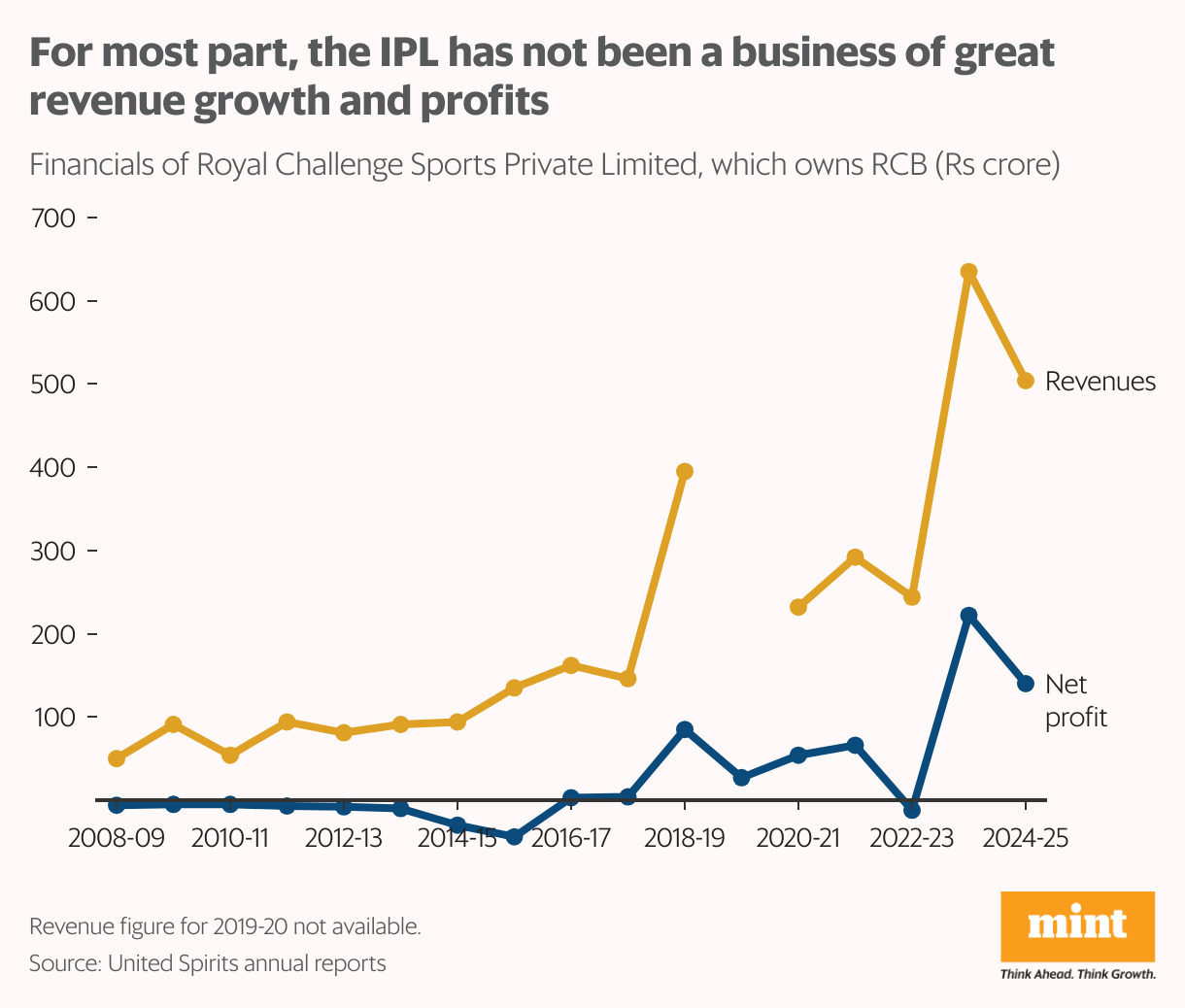
A dramatic improvement in the financial performance of RCB is not a realistic possibility. Revenues of IPL teams are heavily linked to central broadcasting deals stuck for the IPL as a whole. Team revenue tends to move in a band, till the next broadcasting deal is announced. The current broadcast deal runs from 2023 to 2027, and saw the per-year value shoot up from ₹3,270 crore in the previous five-year cycle to ₹9,678 crore.
Thus, for instance, RCB’s revenue hovered in the sub- ₹100 crore band in the first seven years, and is currently in the ₹500-600 crore band. Post-2027, it will probably glide into a higher trajectory. After posting losses in its first decade, RCB is profitable, but again there are limits to that growth. RCB is also staring at the inevitability that its prime cricketing asset, Virat Kohli, is at the tail end of his cricketing career.

View Full Image
Value in valuations
Revenue and profits matter at a base level, but ownership of sports franchises is also about a lot of other things. It’s about visibility—think, film stars and business magnates. It’s about soft power—sovereign arms of Middle-Eastern countries investing in European football clubs. It’s about nurturing a fanbase—the collective ownership model of several European football clubs.
Wealthy owners don’t make money on a going basis in sports. They make money when the asset changes hands. In popular leagues, valuations tend to rise and rise in the medium-term and the long-term. That’s been the case with the IPL. A main reason is the finiteness of the asset. There are only 10 IPL teams, and any expansion is regulated.
Each time the IPL has added new teams, new valuation benchmarks have been set, as happened in 2010 and in 2021. If a sale of either franchise, RCB or Rajasthan Royals, were to happen now, it is likely that the previous benchmark of about $860 million will be breached.
The question is by how much. The numbers being thrown about for RCB range between $1.2 billion and $2 billion. At the lower end of that band, a valuation of $1.2 billion will value RCB at 21 times its 2024-25 revenue. Going by established precedents and current valuations in sporting leagues across the world, that is premium valuation.
The general norm is 6-10 times revenue. Real Madrid, the world’s most valued football club, is valued at 6 times revenue, according to the Forbes 2025 ranking of the world’s most valuable football teams. Manchester United and Barcelona are valued at revenue multiples of 7.9 and 6.9, respectively.
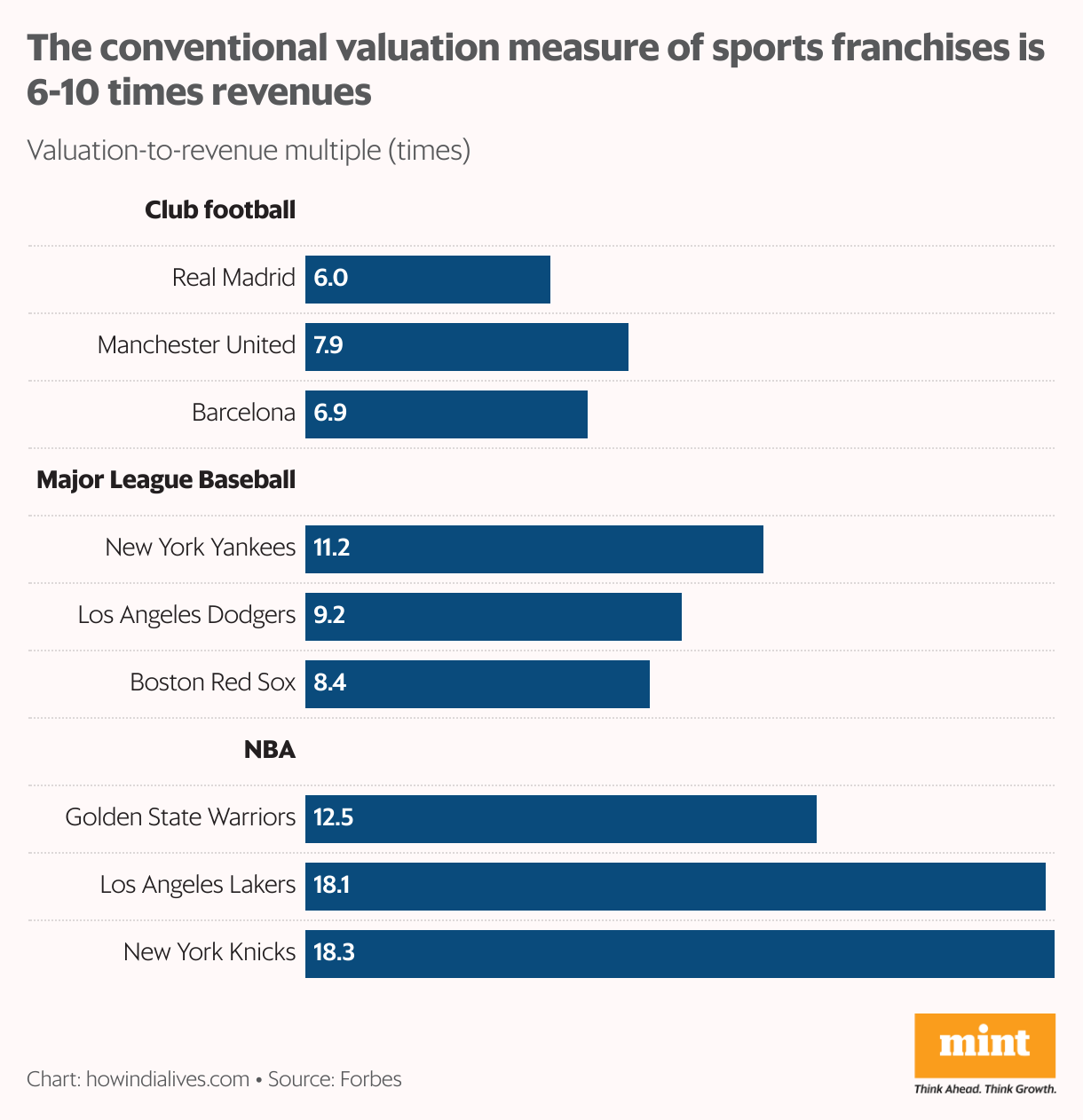
To put this $1.2 billion in perspective, at that valuation, RCB would be the 16th most valued football club in the world. At $1.2 billion, it will be the same as Inter Miami, the team that Lionel Messi plays for. Inter Miami’s latest revenue was $180 million, giving it a revenue multiple of 6.7 times.
In the US, the National Basketball League (NBA) commands higher revenue multiples that are more in the nature of the valuation that the owners of RCB and Rajasthan Royals would be seeking. And that’s anything but a done deal.
howindialives.com is a search engine for public data.
Key Takeaways
- Diageo India has initiated a strategic review of its investment in its 100% subsidiary that owns the two Royal Challengers Bengaluru (RCB) cricket franchises.
- Diageo India is gaining little from RCB. In 2024-25, RCSPL accounted for less than 2% of United Spirits’ gross revenue of ₹27,276 crore.
- The valuation numbers being thrown about range between $1.2 billion and $2 billion.
- At the lower end of that band, RCB will be valued at 21 times its 2024-25 revenue.
- The general norm is 6-10 times revenue.
- Real Madrid, the world’s most-valued football club, is valued at 6 times revenue; Manchester United and Barcelona at 7.9 and 6.9 times, respectively.
- Revenue of IPL teams are heavily linked to central broadcasting deals stuck for the IPL as a whole.
- A dramatic improvement in the financial performance of RCB is not a realistic possibility.
- RCB is also staring at the inevitability that its prime cricketing asset, Virat Kohli, is at the tail end of his cricketing career.

